
Tracking technologies for load carrier control
Industrial circulation processes require tracking that aligns with operational standards – not with individual technology trends. BOX ID relies on standardized solutions that combine scalability, cost efficiency, and long-term control.
Our Customers














Two technologies. One system.
BOX ID follows technological developments – but only where they are operationally meaningful and create real added value in circulation. Our solutions BLE Hybrid Tracking and Active Tracking are based on clearly defined standards that are proven in industrial RTP processes. Complemented by app-based process events and open APIs, this creates a seamless system to control load carrier circulation.
BLE Hybrid Tracking
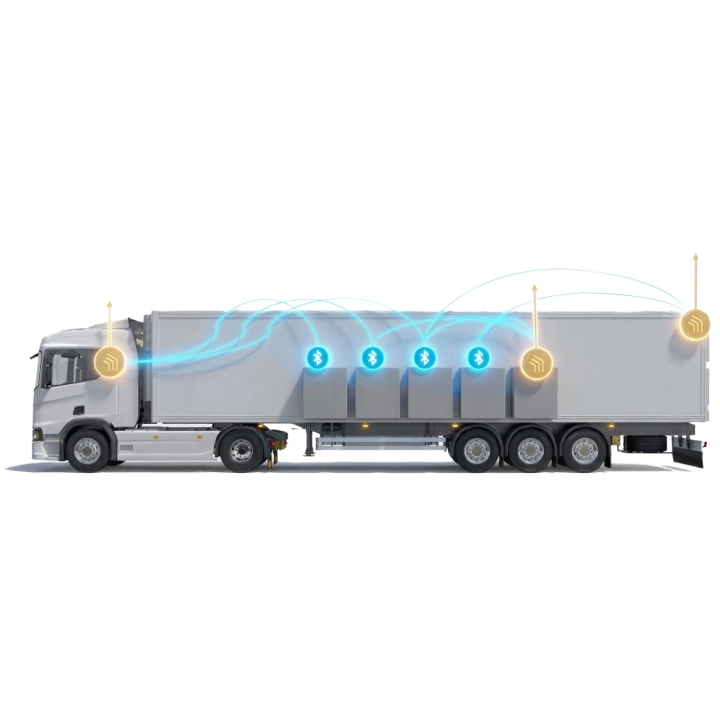
From production and warehouses to depots and multi-site circulation: In everyday industrial logistics, meter-precise positioning of individual load carriers is rarely the key challenge. What matters is where inventory is located, how it moves through process zones, and how long it remains there. BLE hybrid architectures combine scalability with precise transparency: energy-efficient BLE enables tracking of large fleets, stationary gateways deliver exact zone data in facilities, and mobile gateway assets transmit their own position and that of surrounding assets using a mesh principle.
BLE beacons as scalable asset standard
End-to-end transparency within and outside fixed locations
Indoor and outdoor transparency
BOX ID uses a hybrid BLE tracking model that logically connects indoor and outdoor transparency. This creates visibility not only within facilities, but across actual circulation flows – including transport phases – without equipping every load carrier with its own cellular connection.
BLE beacons on load carriers as scalable asset standard
Static gateways for zone-based detection at own facilities and at suppliers
Mobile gateways capture BLE signals outside own facilities
Continuous inventory and movement information end-to-end
Benefits of BLE Hybrid Tracking
visibility
Scalable transparency
Cost-effective tracking for large RTP and load carrier fleets – without individual device connectivity.
motion_sensor_active
Circulation monitoring
Cross-process visibility across plant, transport, and partner locations.
query_stats
Optimization foundation
Reliable data basis for idle time, circulation, and inventory optimization.
Control for critical circulation
Once load carriers leave the facility, complexity and risk increase: locations are no longer unambiguous, returns are delayed, and bottlenecks emerge outside direct control. For precisely these circulation flows, BOX ID relies on active tracking with LTE Cat 1.
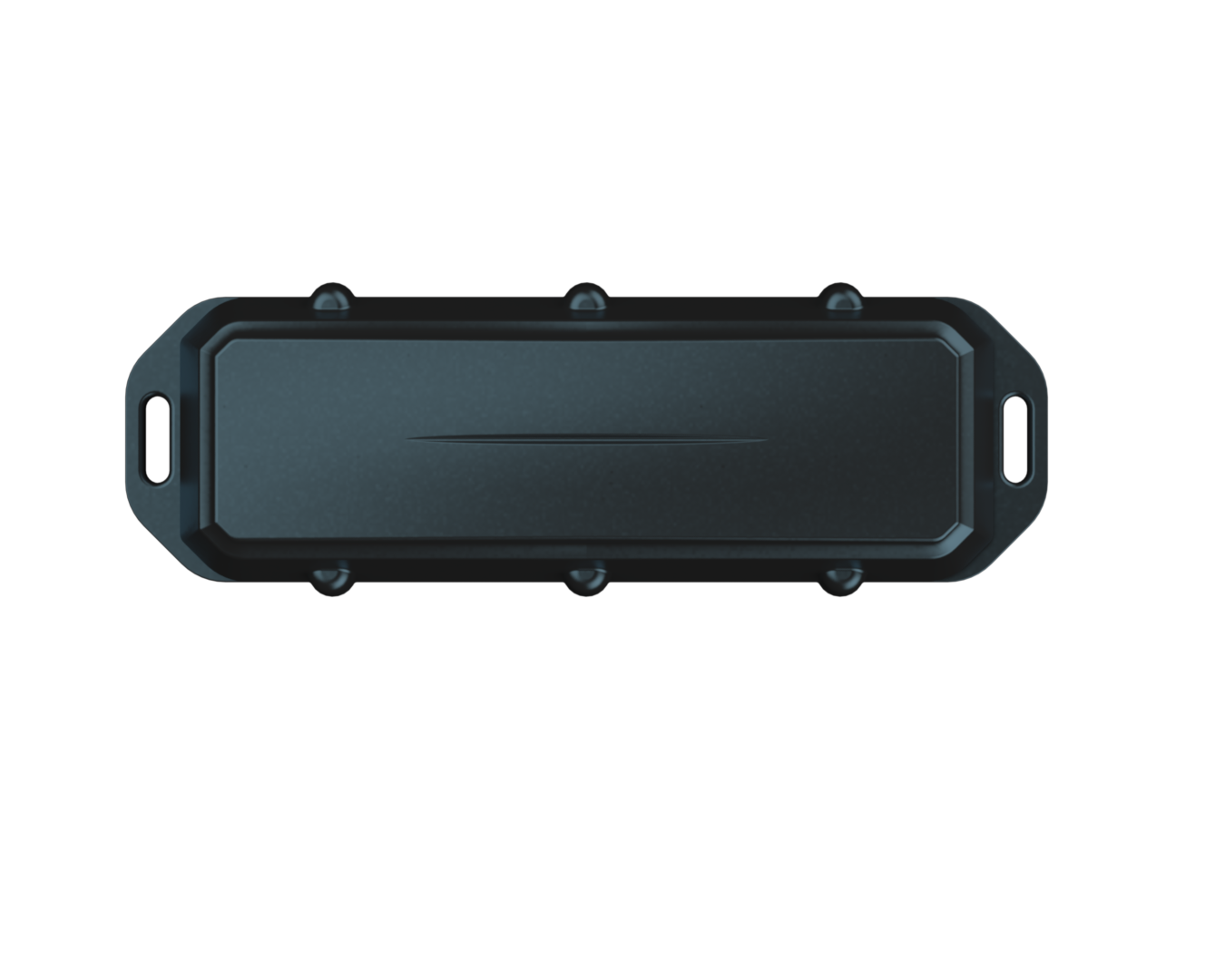
An active tracker combines GPS, WiFi positioning, and cell ID localization in one device and ensures reliable worldwide localization. Additionally, integrated condition monitoring enables tracking of movement profiles or temperature curves.
Worldwide reliable connectivity and roaming
Transparency and return even for high-value assets
Ideal for high-value assets
Active tracking has proven particularly effective in circulation of high-value, sensitive load carriers – such as in glass, window, facade, or specialty rack logistics – as well as in after-sales and spare parts management across regional distribution centers. Despite this functional depth, the system is designed for maximum energy efficiency and achieves a lifespan of up to 8 years – engineered for long-term circulation without maintenance effort.
Worldwide reliable connectivity and roaming
Location and movement data across complex supply chains
Early detection of deviations and process risks
Transparency and return even for critical assets
Benefits of Active Tracking
security
Data availability
Reliable location data even at unknown locations and in complex international circulation flows.
motion_sensor_active
Controlled circulation
Control and monitoring of critical return processes across location boundaries.
globe_location_pin
Indoor and outdoor
Precise localization inside and outside the facility gate through combined positioning methods.
Operational process data via app and scan events
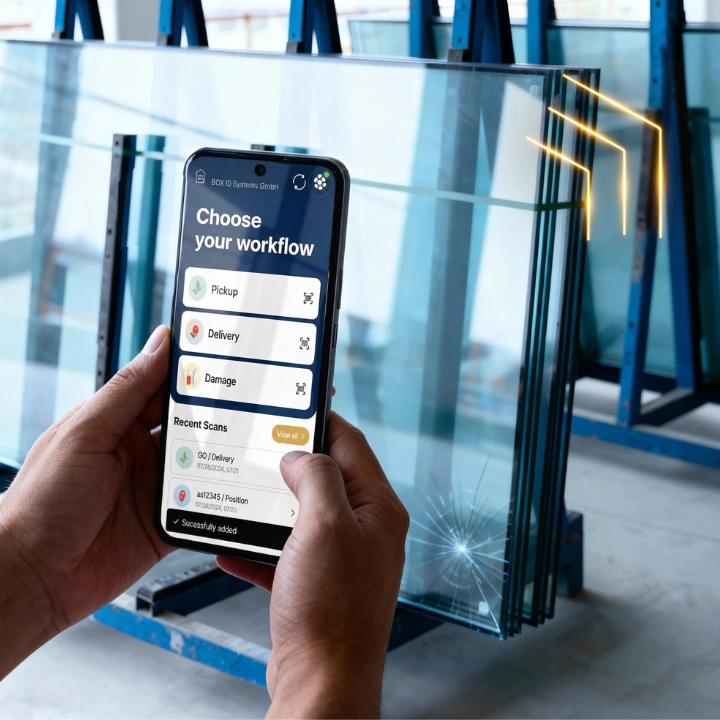
Not every circulation requires more hardware – often it requires clean, reliable process events. BOX ID complements active and passive tracking with targeted mobile interactions along the actual logistics process. Through the BOX ID App and scan events, operational data is captured exactly where it originates – simply, structured, and without media breaks. This information flows into the BOX ID platform in real time, enriching tracking data with critical process and condition context.
Reliable real-time process data
Automated control instead of manual tracking
Typical use cases
The BOX ID App and scan events cover standard operational situations along the logistics process – from handover to damage documentation.
Pickup confirmation
Confirmation upon handover to freight forwarder or logistics partner directly in the process.
Delivery confirmation
Proof of delivery at customer or destination location with timestamp.
Photo documentation
Visual capture of load condition, loading status, or deviations.
Deviation report
Capture damage and deviation reports directly in the process.
Scan events
QR and barcode scans for event capture without active tracking hardware.
System integration and data enrichment
Tracking provides movement – circulation becomes controllable only through process and system context. BOX ID deliberately links location and event data with information from existing third-party systems. Through open REST APIs, ERP, WMS, and TMS data are integrated, so load carriers can be logically connected with orders, routes, customers, or responsibilities.
Assignment of assets to orders, shipments, and routes
Integration of inventory and booking logic from ERP systems
Process context across partners, locations, and time windows
BOX ID as central control layer in existing IT landscapes
Technological basis of our tracking standards
Our tracking solutions are based on standardized device architectures that combine multiple positioning and transmission technologies – purposefully, cost-effectively, and operationally meaningful. BOX ID does not rely on individual technologies, but on clearly defined tracking standards.
BLE Hybrid and Active Tracking use different positioning and connectivity methods depending on the use case to optimally balance reliability, battery life, and cost structure. What matters is not the technical method, but the stable and consistent data foundation that emerges for controllable circulation.

Still looking for the right technology?
You want to go beyond the digitalization of your industrial transport and logistics processes to manage them sustainably and efficiently?
FAQ
Which positioning methods exist in asset and load carrier tracking?
In industrial asset tracking, three basic positioning methods are used: satellite-based positioning (GPS/GNSS), WiFi-based positioning, and cellular-based positioning (cellular positioning). Each of these methods has different strengths in terms of accuracy, availability, energy consumption, and deployment environment.
When is GPS the right positioning technology?
What is cellular-based positioning (cellular positioning)?
Why does BOX ID combine different positioning technologies?
Which use cases are BLE Hybrid Tracking particularly suited for?
- large RTP and load carrier fleets
- circulation with clearly defined transport means
- scenarios with focus on scalability, battery life, and cost-effectiveness instead of individual asset precision
Why does BOX ID focus on LTE Cat 1?
Why doesn't BOX ID use LPWAN networks as standard?
What role does the BOX ID App play in the tracking system?
How does BOX ID ensure long-term future-proofing?
What is the difference between GPS, WiFi, and cellular-based positioning?
The positioning methods differ mainly in how location is determined and where they work reliably:
- GPS/GNSS determines positions via satellite signals and is particularly suited for outdoor tracking and multi-site circulation.
- WiFi positioning uses available WLAN networks and is often deployed in urban or semi-industrial environments.
- Cellular positioning determines positions roughly via cellular towers and typically serves as supplementary or fallback-based positioning.
In practice, these methods are combined to avoid data gaps.
What is WiFi-based positioning used for?
WiFi positioning is used as a supplementary positioning technology when WLAN infrastructure is available. Accuracy is lower than GPS, but can provide additional location information in urban or partially covered areas.
What does BLE Hybrid Tracking with mobile gateways mean?
This allows large RTP fleets to be monitored cost-effectively and scalably across facility and transport phases.
Which cellular and radio networks are used in asset tracking?
When are LTE-M or NB-IoT used?
Can BOX ID be used without active trackers?
Why is tracking alone insufficient to control circulation?
Further questions?
Talk to us about your specific tracking requirements.