
Control RTP flows in commercial vehicle programs
In commercial vehicle production, a high degree of model variety and high-value specialized load carriers meet with plants distributed across the globe. BOX ID brings transparency to these complex networks and makes your assets manageable across all locations.

Our Customers














Complex instead of schedule-driven
Although commercial vehicle production is less schedule-driven than passenger car production, it is structurally more complex. Components are larger and more valuable, often being project-specific, which makes load carriers expensive and not easily interchangeable.
International supplier networks and long lead times result in an incomplete view of actual inventory and return flows. This ties up capital unnecessarily in difficult-to-scale asset structures.
Specialized racks circulate across national borders without any central control.
Long distances and complex return routes can significantly extend cycle times.
New platforms often result in separate fleets without network-wide consolidation.
Special load carriers often remain tied up in the network after program changes, without being used.
Common challenges in asset management
Fragmented network structures create blind spots that disrupt operational processes. Without a consolidated view of international inventories and workflows, inefficiencies arise that directly affect the cost-effectiveness of your programs.
International circulation
Large-volume or component-specific load carriers circulate across national borders without consolidated network transparency.
Capital tied up
Long distances, sea or rail transport, and complex return routes significantly extend cycles.
Program fleets
New platforms or model variants result in separate asset structures that are rarely consolidated.
Asset value
Compared to passenger car production, racks are often custom-made and require significant investment.
Heterogeneity
Supplier structures are more heterogeneous, IT maturity levels vary, and transparency is rarely available across systems.
Lifecycle gap
After program changes, specialized load carriers either remain unused or are not systematically reallocated.
RTP management for high-value asset structures
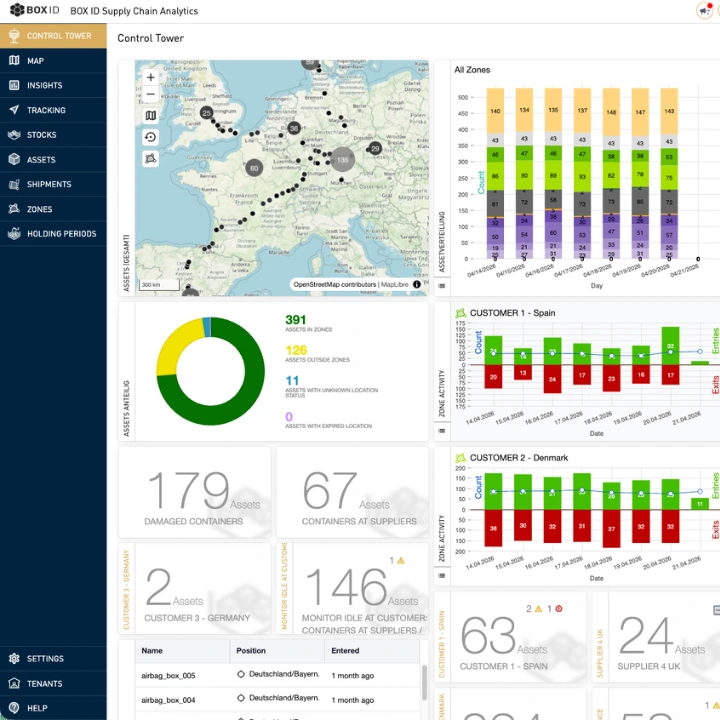
BOX ID consolidates location, circulation, and status data across international plants, suppliers, and logistics partners. This enables active control over complex, specialized racks, from analyzing long downtime periods to integrating with ERP systems. The platform provides a robust basis for decision-making regarding your global asset governance.
Structured support for program-specific fleets over the years
Seamless integration with ERP, EWM, and production systems
Relevance to the buying center
Efficient load carrier management in commercial vehicle production requires collaboration among strategic, tactical, and operational functions. BOX ID provides each role with the data foundation necessary to align individual process goals with cross-site network governance.
Program management
Requires transparency regarding fleet requirements by program and platform.
BOX ID provides a solid basis for decision-making regarding investment and ramp-up planning.
Global logistics
Manages international shipments and returns.
BOX ID provides visibility into transport routes, downtime, and asset distribution.
Asset management
Manages high-value specialized equipment.
BOX ID provides lifecycle transparency and reduces tied-up capital in project fleets.
Supply chain
Requires a cross-site view of RTP inventory.
BOX ID consolidates fragmented partial inventories into a centralized network view.
With BOX ID, commercial vehicle manufacturers can achieve
savings
Less capital tied up
High-quality load carriers are used transparently and sized to meet specific needs.
sync
Stable circulation
Long transport and idle times are visible and can be actively managed.
hub
Consolidated fleets
Parallel structures can be reduced and reallocations are made easier.
insights
Better investments
Transparent usage patterns enable informed decisions about new purchases or renovations.
language
Globale governance
Global transparency replaces local optimization.
What our customers say about BOX ID
Reduce costs, convince customers
"Working with BOX ID Systems, we were able to optimize costs for operating shuttle packaging in a Siemens unit by implementing BOX ID's asset tracking and monitoring solution. In addition to transparency and cost savings, we also achieved higher customer satisfaction."
Ralf Dupal
Senior Consultant Production & Logistics, Siemens Advanta Consulting

Better decisions, faster
"When we began our partnership with BOX ID, we were truly impressed. Their deep knowledge of the logistics industry and their expertise are simply excellent. The platform is easy to use and provides managers and operations leaders with the insights they need to make better, faster, and fact-based decisions. BOX ID has proven they are able to handle complexity and deliver powerful out-of-the-box reporting solutions."
Sam Sharief
COO, Thinxtra, The IoT Telco

Cost-effective ERP integration
"CANCOM chose Sigfox and BOX ID because the tracking solution via 0G network connectivity is particularly energy-efficient, low-maintenance, and cost-effective for digitization and load carrier management. The solution offers significant advantages over alternative services we tested based on 3G/4G/5G cellular networks, as it allows us to cost-effectively integrate load carriers into ERP and the solution works without roaming fees. The streamlined handling in the very intuitive backend also convinced us."
Stephan Huber
Manager Operations Service Factory, Cancom

Always on top of inventory
"With the BOX ID solution, we always have our rack inventory in view – transparency and flexibility that really positively impact our business."
Daniel Freund
Managing Director, Weha-Therm
Measurably optimized logistics
"Damage to packages is avoided, transport on the truck is space-saving, we save packaging aids like film, transport to individual areas is faster, and process steps are optimized.
Roland Huber
Logistics Project Management, FEGA & Schmitt
No need for new purchases
"Since we implemented the BOX ID solution, we get empty racks back from our customers much faster, always have enough racks available, and haven't needed to buy new ones."
Asta-Magdalena Suttner
Purchasing / Marketing, Glashandelsgesellschaft Profi mbH
Real-time transparency
"We were able to integrate process mining in the testing phase and quickly gained helpful insights into how our load carriers actually perform."
Diana Förster
Logistics, INDEX Werke
Success in international programs
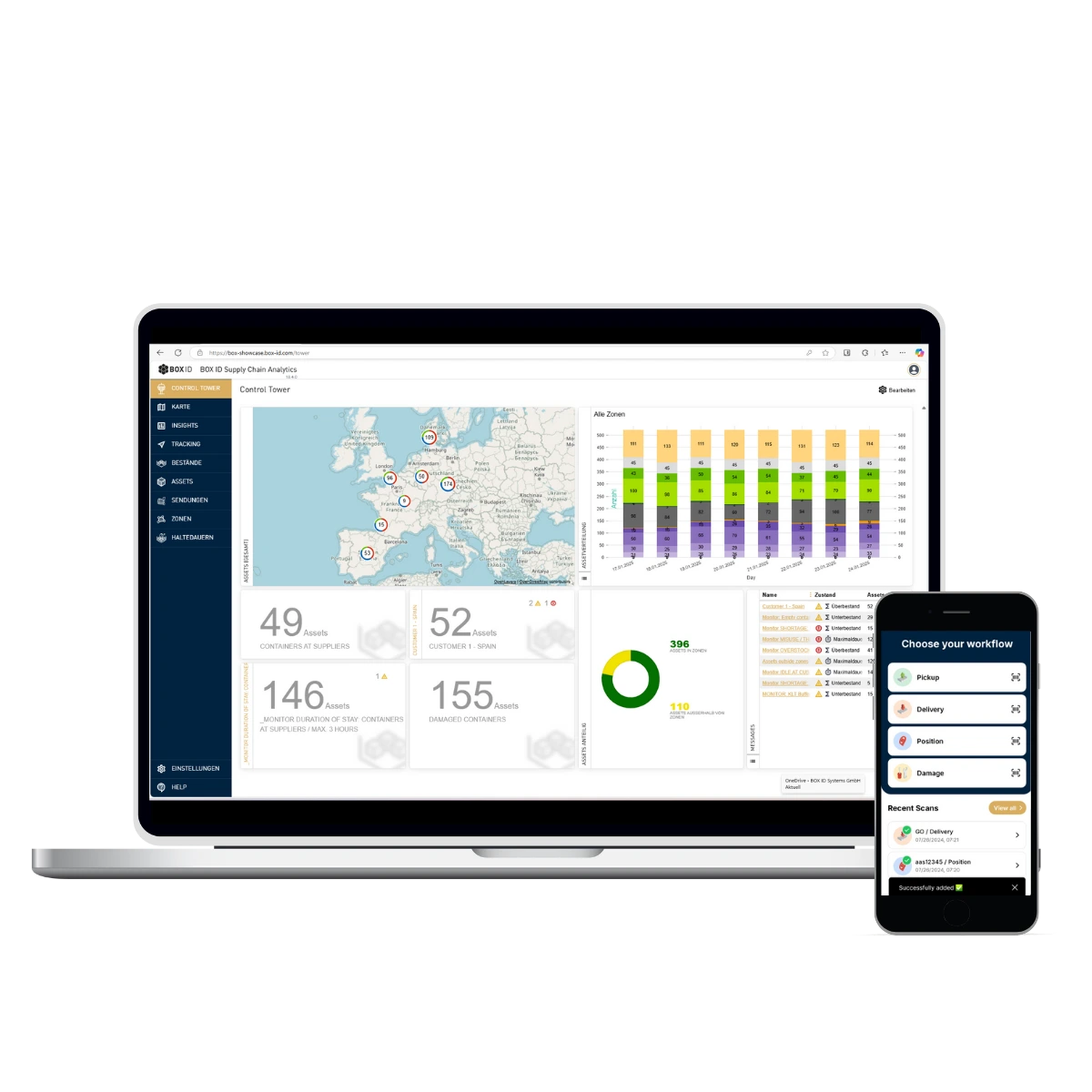
Manufacturers of trucks, buses, and specialty vehicles use BOX ID to consolidate high-value specialty load carriers internationally, reduce parallel fleets, and manage program and platform transitions in a structured manner. Centralized control measurably reduces capital tied up in the network. International asset structures do not become larger, but more efficient.
High-quality specialized cargo carriers are networked across international locations.
Reducing parallel fleets measurably lowers the capital tied up in special RTPs.

Manage international cycles. Reduce tied-up capital.
With BOX ID, you can track pool and special load carriers worldwide. Transparency regarding long cycles, program-specific fleets, and international facilities lays the foundation for sustainable asset management and reduces the amount of capital tied up in your network.
Our Customers
RTP management in commercial vehicle production
Answers to the most frequently asked questions about managing load carrier cycles in commercial vehicle production.
In what ways does RTP management differ between commercial vehicle and passenger car production?
Production volumes are lower, components are larger and of higher quality. Production cycles are more international and longer, and specialized racks have a higher asset value.
What role does international asset management play?
Assets are distributed globally. Without centralized transparency, parallel holdings and inefficient reallocations arise.
What technologies are used?
Depending on the level of internationality and asset value, one of the following tracking methods is used: QR workflows, BLE hybrid tracking, or LTE Cat 1 tracking.
Why is the amount of capital tied up in commercial vehicle RTP fleets so high?
Custom racks are often custom-made and expensive. Long lead times further increase the capital investment.
Can program-based fleets be consolidated?
Yes, lifecycle transparency allows for a more structured approach to platform transitions and enables fleets to be adapted to meet specific needs.
How quickly can results be achieved?
Pilot projects and defined programs often yield measurable improvements in transparency and capital allocation within a few months.
Can't find the answer to your question here?
Talk directly to our team. We would be happy to advise you on your specific case.
Book a call now
Do you have complex requirements or are you looking for the right solution for your load carrier management? Let's talk.
E-Mail:
info@box-id.com
Phone:
+49-(0)89-2190973-60
Location:
BOX ID Systems GmbH
Lichtenbergstraße 8, c/o gate
DE-85748 Garching near Munich
Solutions for your industry
Every industry has its own load carriers, processes, and challenges. BOX ID adapts to the requirements – with industry-specific tracking and management.
Glass and Window Construction

Agricultur and construction

Special-purpose and military vehicles

Passenger cars