
Control circulation of load carriers
In time-sensitive automotive supply chains, millions of pool and customized load carriers move daily between OEMs, Tier 1, Tier 2, and 3PL providers – across plants and national borders. BOX ID makes these cycles visible and operationally controllable: from SOP through ramp-up to stable series production.

Our Customers














Fragmented networks, lack of transparency
The production of passenger cars is not a closed system, but rather a fragmented network of OEMs, Tier 1, Tier 2, and 3PLs. Load carriers circulate across plants, countries, and company boundaries, often without end-to-end visibility.
Although parts flows are planned digitally, the physical movement of pool and custom load carriers is often only partially visible. As a result, many networks look like this:
There is no consolidated view of actual inventory levels by plant or supplier.
Actual circulation and downtime remain unknown.
The use and location of component-specific special load carriers are unclear.
There are no clear lines of responsibility in the event of deviations.
Common vulnerabilities in passenger car production
Many automotive networks have the same structural inefficiencies. These inefficiencies arise from a lack of transparency and control throughout the system. They result in unnecessary capital being tied up in oversized safety stock and RTP fleets.
Non-transparent circulation
Empty containers are distributed across multiple partners and locations. Returns are handled on an ad hoc basis rather than systematically. Inventories are fragmented across the network.
Oversized fleets
Additional containers mitigate ramp-ups, model changes, and volume fluctuations. A lack of transparency leads to reactive management and tied-up capital.
Lack of consolidation
Each plant optimizes its operations locally. There is no cross-site overview. Consequently, duplicate inventories arise even though sufficient containers are available globally.
Unidentified special load carriers
Component-specific racks may be blocked, allocated incorrectly, or remain unused after a production run change. Without lifecycle management, investments remain tied up.
Delayed response
Operational issues, such as downtime, misrouted shipments, and inventory shifts, are only detected once they arise. There is a lack of transparency regarding the gaps in the supply chain.
Manual coordination
Emails, Excel spreadsheets, and bilateral coordination replace a unified data foundation. This makes decision-making processes slow, inconsistent, and dependent on specific individuals.
RTP management for tact-based serial production processes
BOX ID integrates location, circulation, and status data into a centralized control logic for serial production. Load carriers are not only tracked but actively managed with real-time visibility into full and empty containers, automated return logic, analysis of circulation and idle times, and lifecycle tracking for special load carriers.
The platform integrates directly with ERP, EWM, and production systems. This creates a robust foundation for making decisions about production planning, scheduling, and the shop floor.
Automated returns and real-time inventory control
Seamless integration with ERP, EWM, and production systems
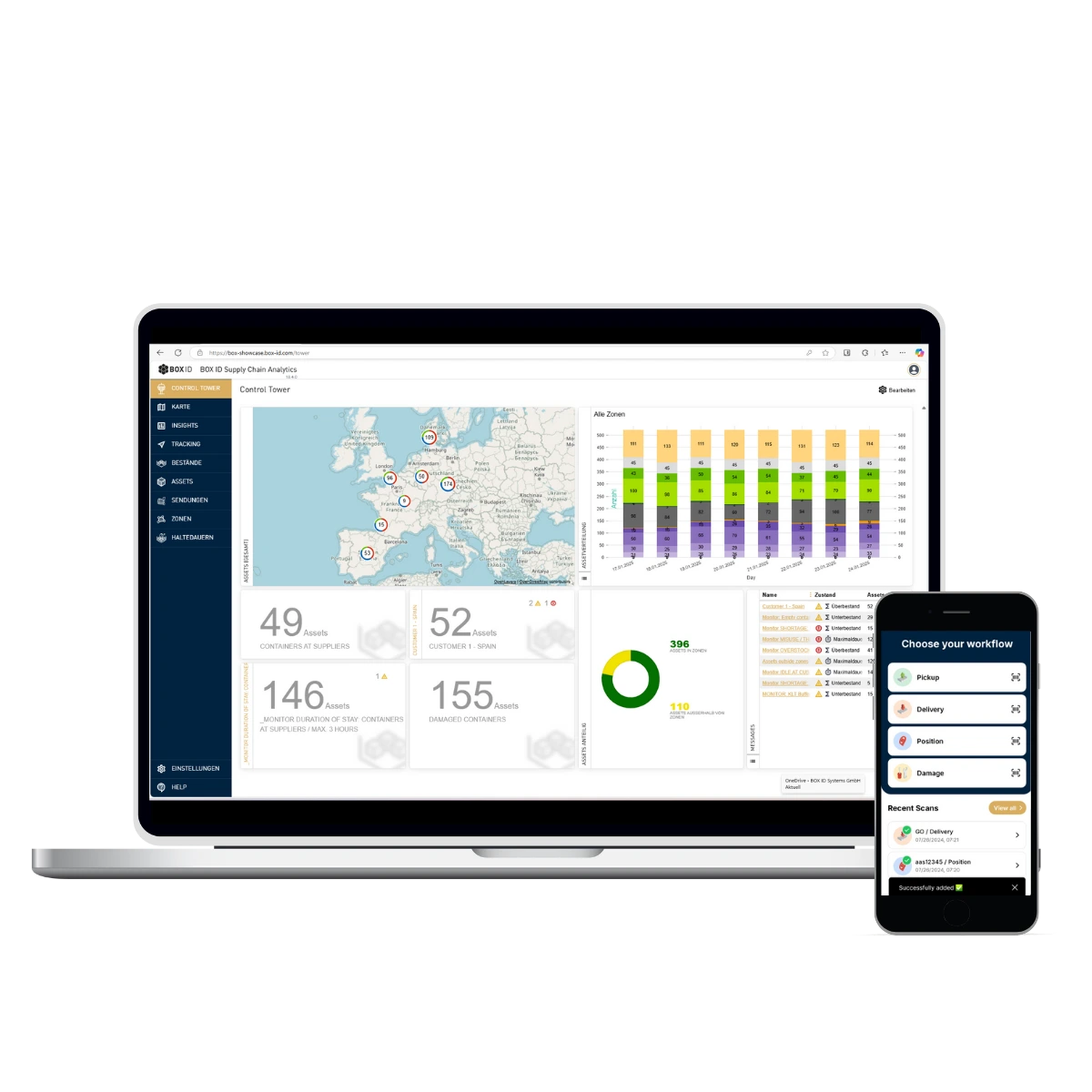
Transparency for every role in the production environment
Load-handling processes in passenger car production require several key functions. Each role requires transparency, but with an individual focus.
Production planning
Realistically size production runs for SOP, ramp-up, and series production.
BOX ID provides reliable production run data, which serves as a basis for sound production planning instead of precautionary over-procurement.
Empty container management
Manage returns between OEMs, Tier 1 suppliers, and 3PLs.
BOX ID makes returns, downtime, and discrepancies visible and manageable across all locations.
Inbound logistics
Get visibility into the status and availability of full containers.
BOX ID integrates location and process data to identify discrepancies early on.
Shop floor & operations
Ensuring operational stability through efficient workflows.
Dashboards and status logic provide visibility into risks before they affect day-to-day operations.
With BOX ID, OEMs and suppliers in the passenger car industry can reach
%
Less shrinkage
Transparent inventory cycles can reduce losses and misuse by up to 95%.
%
Optimized turnaround times
Downtime is made visible, and returns are actively managed. Fleet requirements are reduced by up to 20% on average.
%
Reduced tied-up capital
Depending on the use case, excessive safety stock can be reduced by up to 15%.
verified
Reliable line supply despite network fragmentation
Bottlenecks are detected early, and production interruptions are avoided.
speed
Higher OEE and predictability
The line supply becomes predictable rather than reactive.
What customers & partners say about BOX ID
Complex logistics, easy digitalization
"The BOX ID system allows us to easily digitalize complex logistics processes. The open system architecture and seamless integration into our existing IT systems were of particular importance to us. The automated recording of location and movement data for our EPP components provides us with valuable information we can use to shorten cycle times, optimize inventories, and identify bottlenecks at an early stage. From the very beginning, our collaboration with BOX ID has been based on partnership and a solution-oriented approach.
Lubomir Ogurcak
Logistics Manager, Izoblok

Gain visibility, reduce logistics costs
"These solutions enable transparency throughout the entire supply chain if they are implemented correctly. This makes it possible to increase efficiency in the use of containers and load carriers and thus optimize supply chain costs."
Thomas Grabscheit
Purchasing / Senior Expert AutoID at MHP Management and IT Consulting GmbH
Real-time transparency
"We were able to integrate process mining in the testing phase and quickly gained helpful insights into how our load carriers actually perform."
Diana Förster
Logistics, INDEX Werke

Cost-effective ERP integration
"The solution offers significant advantages over alternative services we tested based on 3G/4G/5G cellular networks, as it allows us to cost-effectively integrate load carriers into ERP and the solution works without roaming fees. The streamlined handling in the very intuitive backend also convinced us."
Stephan Huber
Manager Operations Service Factory, Cancom

Success in international projects
International manufacturers use the BOX ID system to consolidate high-quality specialized load carriers, reduce parallel fleets, and systematically manage program and platform transitions.
This centralized management measurably reduces capital tied up across the entire network. The result: International asset structures do not grow larger, but they are utilized significantly more efficiently.
Making global logistics flows transparent
Transparent insights into global logistics flows lay the foundation for operational optimization.
Measurably reduce tied-up capital
By avoiding downtime, tied-up capital in the load carrier pool is directly reduced.

Manage circulation. Free up capital.
With BOX ID, you can always keep track of your pool and special load carriers in passenger car production. Real-time transparency, automated returns, and lifecycle management provide a stable foundation for your production process.
Our Customers
RTP Management in passenger car production
Answers to the most frequently asked questions about managing load carrier cycles in passenger car production.
Why is RTP management particularly challenging in mass production of passenger cars?
What types of load carriers are typically used?
What are the consequences of a lack of transparency?
How do mass production and after-sales differ in RTP management?
How can RTP management reduce the amount of tied-up capital?
What role do special load carriers play in mass production?
Special loading carriers are component-specific and require a significant investment. Without transparency regarding their lifecycle, they remain unused and tied up following model changes or shifts in production volume.
Is it possible to consolidate RTP management across multiple plants?
Yes. A centralized database allows for the management of inventory and inventory turnover across locations, preventing duplicate inventory and local optimization efforts.
In what ways does RTP management support the ramp-up and model changeover phases?
Transparent inventory data allows for realistic fleet planning for new production runs or volume adjustments, eliminating the need for precautionary over-purchasing.
What technologies are used?
Depending on the network structure, one of the following tracking methods is used: QR workflows, BLE hybrid tracking, or LTE Cat 1 tracking. This technology is tailored to volume, international scope, and criticality.
How quickly can results be achieved?
Many OEMs start with a pilot plant or a defined supplier structure. The first measurable improvements in transparency and shelf life are often visible within a few months.
Can't find the answer to your question here?
Talk to our team. We're happy to advise you on your specific use case.
Book a call now
Do you have complex requirements or are you looking for the right solution for your load carrier management? Let's talk.
E-Mail:
info@box-id.com
Phone:
+49-(0)89-2190973-60
Location:
BOX ID Systems GmbH
Lichtenbergstraße 8, c/o gate
DE-85748 Garching near Munich
Solutions for your industry
Every industry has its own load carriers, processes, and challenges. BOX ID adapts to the requirements – with industry-specific tracking and management.
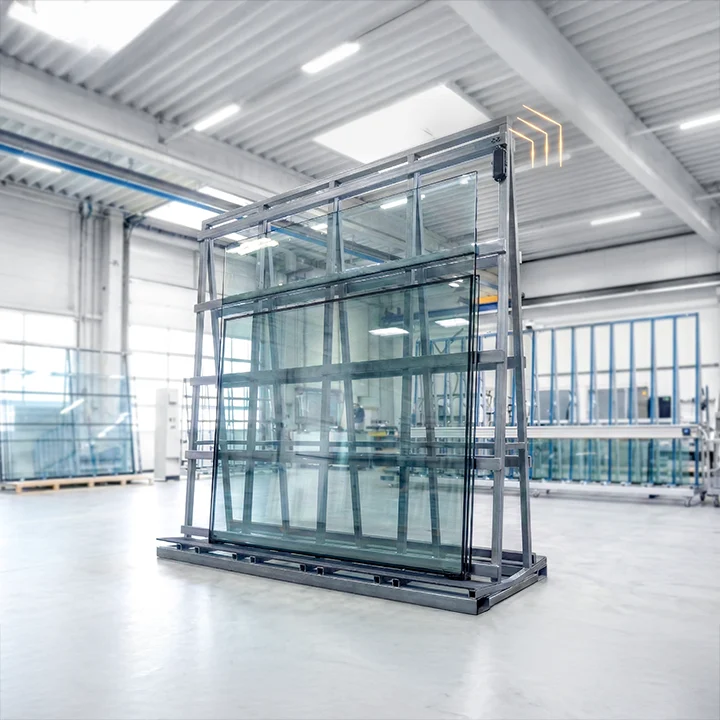
Glass and Window Construction

Agricultur and construction

Commercial vehicles

Special-purpose and military vehicles