
Controllable circulation for industrial reusable transport packaging
BOX ID connects load carriers, IoT data, and software into one integrated system - enabling companies to ensure availability, reduce losses, and control circulation across locations and partners on a reliable data basis.
Our Customers











Efficiency in industrial logistics rarely fails due to technology – but due to a lack of control
Load carriers and reusable transport packaging continuously move across sites, customer locations, 3PL providers, and external circulation zones. Without a seamless system, blind spots emerge in load carrier management: capital ties up, availability declines, and operational problems become strategic bottlenecks.
Truth is: What is not systematically captured, connected, and analyzed cannot be reliably controlled or economically optimized.
The systemic components of BOX ID RTP management
BOX ID consolidates data around load carrier fleets, links it with processes, and creates a reliable foundation to control complex circulation transparently and scalably.
Load carriers
Reusable transport packaging, special load carriers, pool containers, and racks are integral to industrial processes. Physical load carriers are the source of all data. Type, usage context, and circulation structure determine which information is relevant.
Identification
Each load carrier requires a unique identity – regardless of the technology used. Only then can movements, conditions, and histories be reliably tracked.
Movement events
Arrival, departure, handovers, and dwell times capture the actual use of a load carrier throughout its circulation – not as a map, but as a process.
Condition data
Information on availability, loading status, damage, or maintenance needs determines whether a load carrier is operational or must be taken out of service.
Context data
Only by linking responsibilities, partners, locations, and time windows do raw data become controllable and action-relevant.
ERP data
Order data, delivery notes, bookings, and inventory from ERP, TMS, or WMS systems connect the physical movement of load carriers with existing IT logic.
Manual entry
Mobile apps and QR code-based communication enable drivers, logistics partners, and internal staff to capture events such as handovers, pickups, or damage directly within the process.
Event logic
Geofencing, time overruns, or unplanned use make deviations automatically visible and enable targeted escalations instead of manual tracking.
Control logic
Aggregated metrics on circulation times, return rates, utilization, and capital ties form the basis for operational control and strategic decisions.
Our system thinks in processes, not individual technologies
BOX ID does not view logistics merely as a sequence of tracking points, but as a continuous circulation process. Responsibilities, status information, time, and location references are systematically interlinked – independent of deployed hardware and based on clearly defined technical interfaces and integration standards.
Reduced operational control effort
Reliable decision-making criteria based on consistent data

Operational data points for clean processes
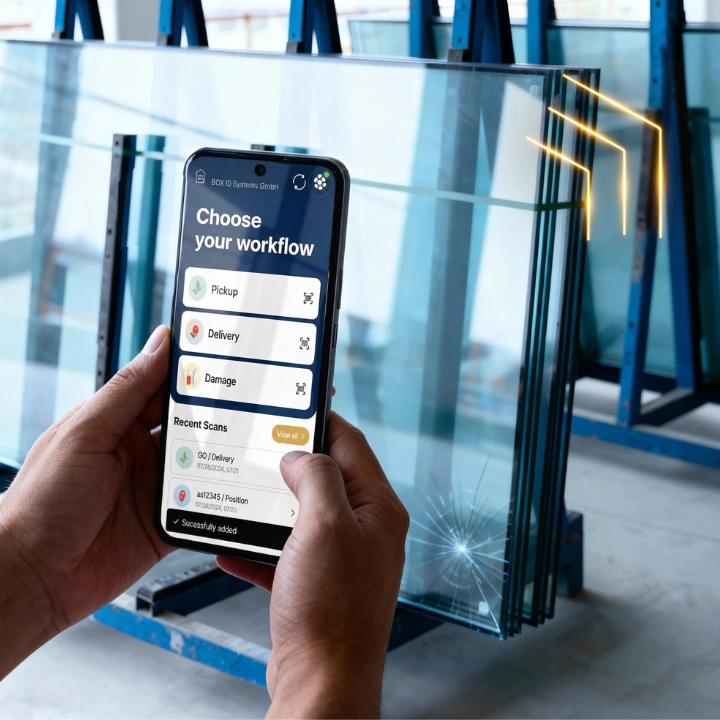
To ensure defined circulation run reliably in operations, BOX ID provides mobile data capture via the BOX ID App. Drivers and other process participants record pickups, deliveries, status changes, and special events directly within the process. The captured data flows back to the BOX ID system contextualized, structured, - without media breaks - and is immediately available for analysis, control, and tracking.
Why BOX ID is not a classic provider
BOX ID is not a pure tracker or hardware provider. Not a replacement for ERP or WMS systems. Not an isolated location or mapping dashboard.
BOX ID is an industrial system platform for reusable transport packaging. The connection layer between tracking, identification, and process data. An orchestrator for circulation, inventory, and container processes. The integration layer between physical operations and existing IT. And scalable control logic for multi-site and partner-spanning circulation.
From system to operational excellence
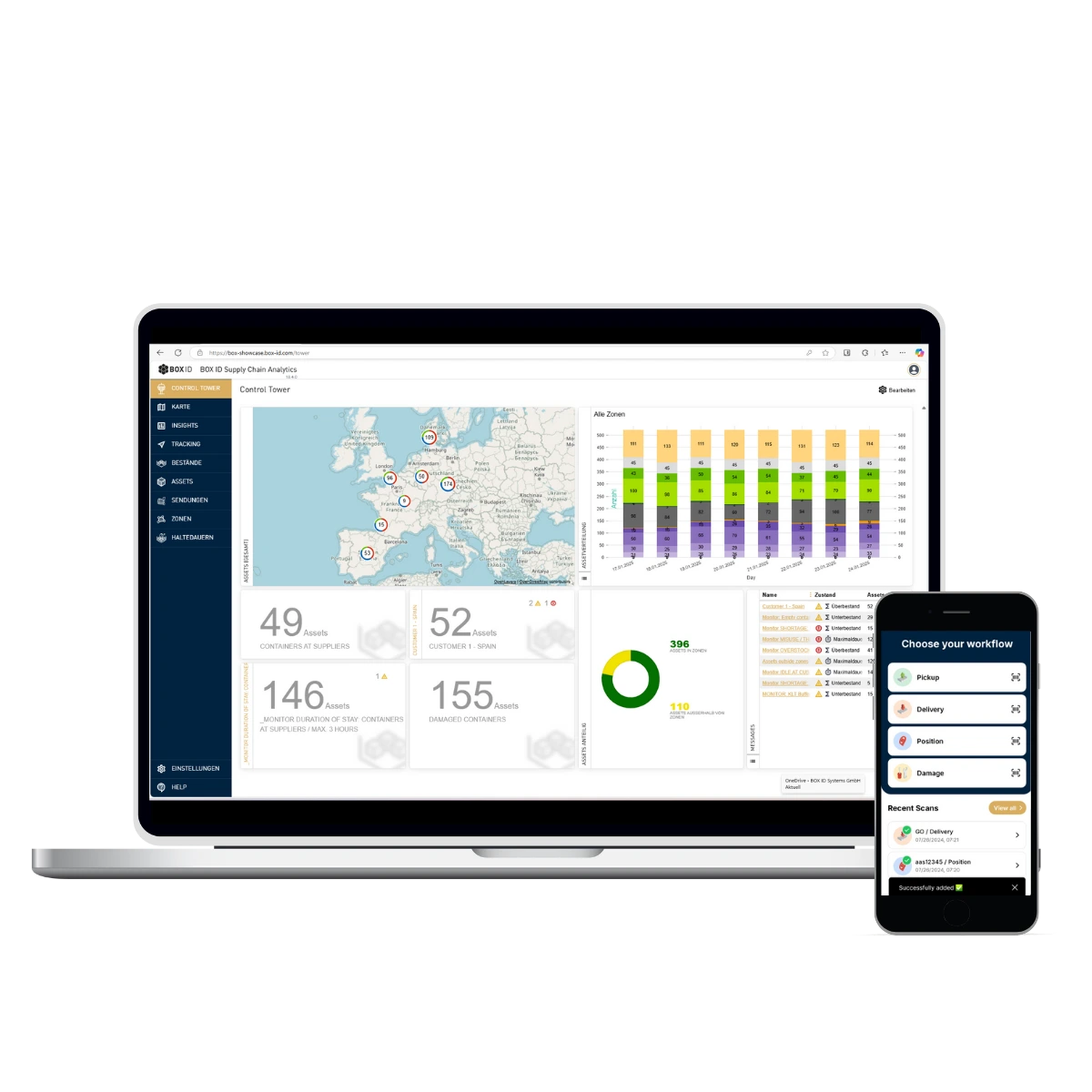
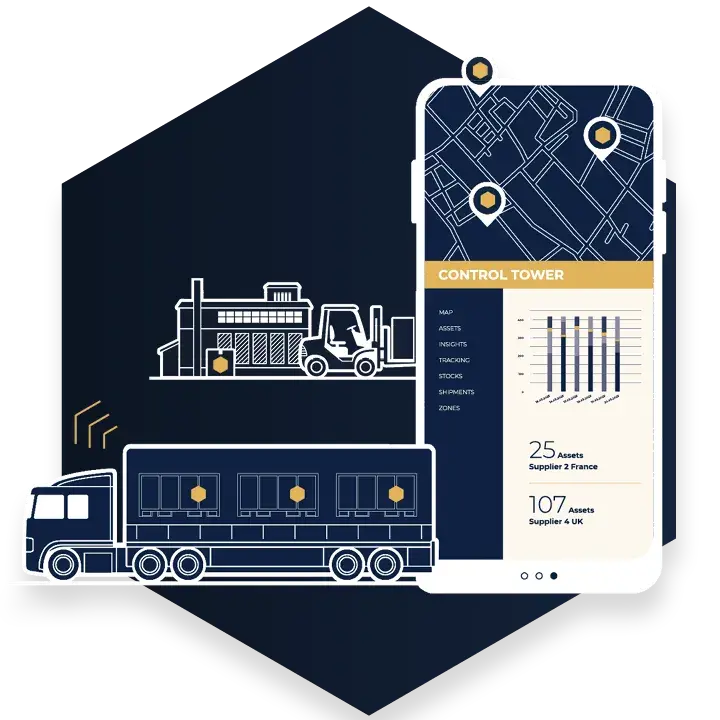
The BOX ID system delivers its value through targeted application. Define processes in the BOX ID software, monitor circulation, analyze metrics, and integrate real-time data into your existing IT landscape.
Measurable results in weeks
Many companies start with a clearly defined use case – for example, managing a specific load carrier type or critical route. Within weeks, operational improvements become visible: reduced loss, more stable circulation, and a clear data foundation for informed decisions. The Starter Edition enables a controlled entry – scalable to full fleet management.
Fast pilot with clearly defined scope
Scalable to company-wide rollout
Our Customers


The right systems enable successful scaling
The BOX ID system is developed for companies that want to go beyond digitalizing their industrial transport logistics - and manage their processes sustainably and efficiently.
The BOX ID System in practice
From fleet management in production logistics and after sales to shipment monitoring and yard visibility
- BOX ID offers the right solution for specific operational challenges.
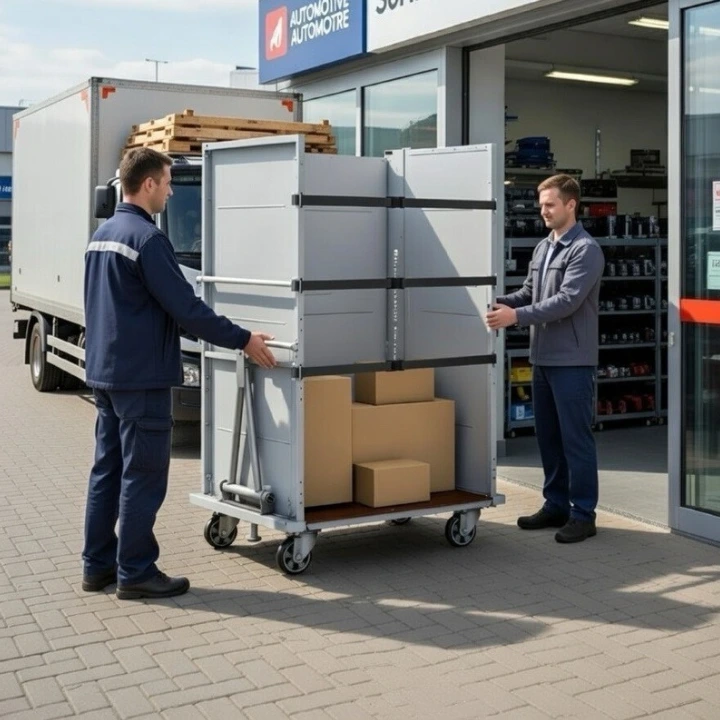
RTP Containers Under Control in Automotive After Sales
From Shipment Monitoring to Yard Visibility

Efficient Fleet Management for Industrial Production Logistics

Frequently asked questions about load carrier tracking
What is load carrier tracking?
What benefits does digital container management provide?
Digital container management systems reduce loss by up to 95%, shorten circulation times, and enable fleet reduction of 20–25%. It allows companies to reduce costs, increase availability, and eliminate manual search processes.
Which technologies are used in load carrier tracking?
Depending on the application, GPS, LPWAN (e.g., LTE-M, NB-IoT), WiFi positioning, BLE, barcodes, or QR codes are used. BOX ID flexibly combines different technologies to enable seamless indoor and outdoor tracking.
How does geofencing work in load carrier tracking?
Geofencing allows the definition of geographic zones. If cargo carriers leave these zones, an alarm is automatically triggered. This enables companies to quickly detect and resolve theft, incorrect loading, or process deviations.
Which industries benefit from the BOX ID solution?
BOX ID is already successfully used in industries such as automotive, mechanical engineering, glass and window manufacturing, wholesale, medical technology, and the postal and parcel sector. In all of these areas, traceability and asset availability are critical.
How quickly can BOX ID be implemented?
With the Starter Edition, a risk-free start is possible within 12 weeks – including hardware, software, and support. Ideal for a proof of value with up to 250 load carriers.
What data does the BOX ID platform provide?
The platform provides real-time data on location, condition, idle times, and container circulation. These features are complemented by automated reports, process analytics, and alerts for deviations or maintenance needs.
Why is load carrier tracking important for the supply chain?
Tracking load carriers (RTPs) is critical for an efficient, transparent, and cost-optimized supply chain. Only by knowing where containers, racks, or pallet boxes are - at all times - can idle times be eliminated, material flows optimized, and production downtime prevented. Particularly in complex multi-supplier chains, digital load carrier management ensures that information on container circulation is available in real time.
How to improve the return rate of transport racks?
High return rates can only be reliably achieved with digital container management. By using modern IoT trackers on RTPs, the system automatically detects when and where a load carrier is delivered or picked up. Combined with geofencing and automated notifications, return delays are identified immediately, allowing delivery partners to be prompted directly to return carriers. This reduces costs, minimizes losses, and increases rack availability in production.
How does IoT help with asset tracking in logistics?
The Internet of Things (IoT) enables the end-to-end digital mapping of physical assets - such as load carriers, RTPs, mesh boxes, or specialized racks. Containers equipped with sensors continuously send location and status data to the cloud. This real-time data enables optimization of turnaround times, downtime reduction, and precise supply chain planning. IoT-based asset management tracking creates transparency, security, and planning reliability across organizational boundaries.
What savings can be achieved with load carrier tracking?
Professional tracking and management of load carriers unlock significant cost-saving potential. Companies using systems like BOX ID report up to 95% less loss and a reduction in container fleet of 15 to 25% (dependent on use case and industry. Manual administrative effort also declines significantly, as search times, email chains, and phone calls for container locating are eliminated. At the same time, fleet utilization increases - making additional investments in new containers almost unnecessary.
Can load carrier tracking help prevent theft?
Yes, modern container tracking is an effective tool to prevent theft and misuse. Geofencing enables the definition of virtual zones – if a container or rack leaves a zone without a planned event, an alert is triggered automatically. Combined with real-time location data and event logs, BOX ID provides both preventive and investigative security solutions with a strong ROI - especially for valuable or scarce assets.
Is there a mobile app for drivers and logistics staff?
Via the BOX ID Driver App, delivery data, bookings, or inventory movements can be linked directly with real-time tracker data captured in the cloud. This enables automated linking of physical movement and digital booking – without manual duplication or system breaks.
Is there a solution for smaller fleets or pilot projects?
Yes. BOX ID offers the Starter Edition for a risk-free entry for companies with smaller container fleets or for test projects. Within just 12 weeks, a complete proof of value can be completed – including hardware, software, training, and support. The solution is designed to scale up at any time, without data loss or the need to reconfigure processes.
What does implementing load carrier tracking cost?
Costs depend largely on fleet size, deployed technologies, and required functionality. As a guideline: The BOX ID Starter Edition starts at €695 per month and already includes hardware of up to 40 devices, software licenses, and support. The system often pays for itself within a year due to its cost-saving potential.
What is a Returnable Transport Item (RTI)?
An RTI is a reusable transport container that circulates multiple times within the supply chain. This includes small load carriers, pallet boxes, IBCs, or specialty load carriers such as racks. RTIs reduce packaging waste, conserve resources, and reduce costs in the long term – provided they are managed efficiently.
What is the difference between passive and active tracking?
Passive tracking uses, for example, QR codes or RFID tags that provide information only when scanned. It is suitable for simple or manual processes. Active tracking, by contrast, uses IoT devices that continuously or event-based send location and condition data to the cloud. This creates real-time data that enables automatic process monitoring – ideal for large fleets or critical supply chains.