
Electrification, autonomous driving, new mobility concepts and increasing sustainability requirements are transforming the automotive industry and its physical supply chains. For load carrier tracking, this raises a key question: Which technology fits which supply chain?
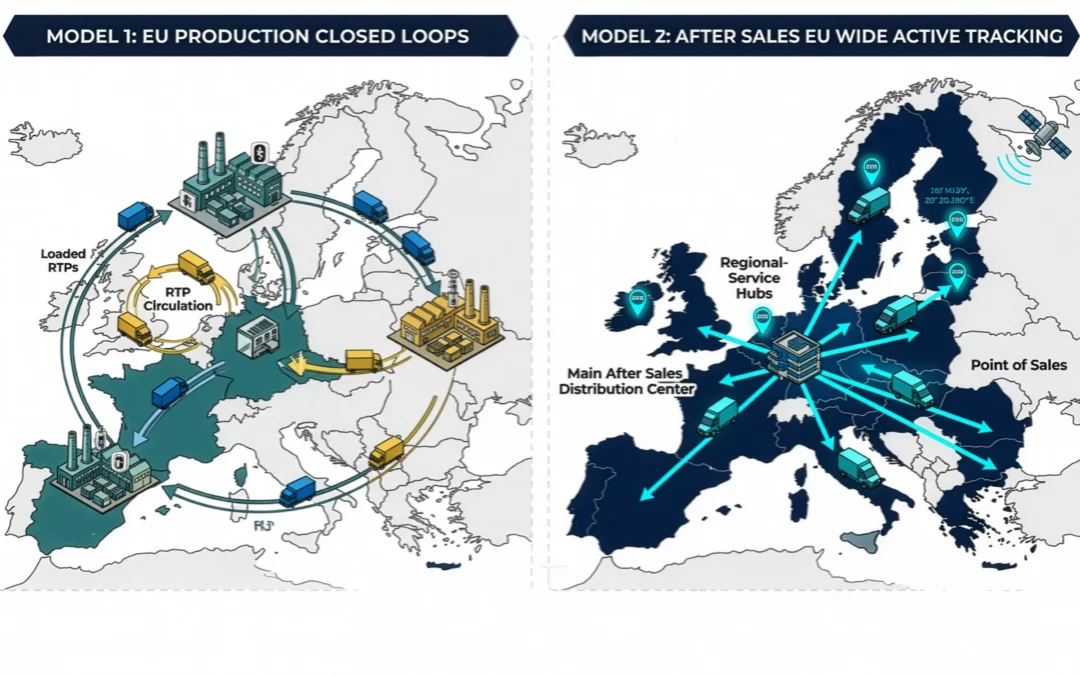
Load carrier tracking in automotive production works with BLE trackers, static gateways and mobile gateways based on a swarm principle because load carriers circulate within known, closed-loop networks. In the automotive aftermarket, active LTE Cat 1 trackers transmit independently because individual load carriers may remain at numerous dealers and workshops.
Automotive logistics have no unified network structure. Production logistics and the automotive aftermarket are based on two fundamentally different network architectures. These structures determines the best load carrier tracking approach for each supply chain. Electrification, autonomous driving and increasing sustainability requirements are adding further pressure to physical supply chains.
The choice between a BLE hybrid architecture and active LTE Cat 1 trackers therefore depends on the structure of the respective supply chain.
Automotive production: fragmented, yet structurally closed
Supply chains in vehicle production are complex. OEMs, Tier 1 and Tier 2 suppliers, international suppliers and global production sites form highly fragmented networks with thousands of individual components crossing national borders. The components are transported in returnable transport packaging (RTP), including mesh boxes, roll cages and special load carriers.
At the same time, the circulation routes remain clearly defined. Load carriers move between known locations:
- Production sites are known.
- Supplier relationships are established over the long term.
- Material flows follow defined processes.
- Load carriers remain within a known network.
The structures of global supply chains also remain closed. The primary risk is process instability, including bottlenecks, disruptions in circulation and inefficient fleet utilization. Load carrier tracking architectures that are capable of efficiently managing large fleets are necessary to make these risks visible. Our BLE systems are technically compatible in this network structure.
BLE tracking in automotive production: scaling with the swarm principle
BLE hybrid architectures offer three strategic advantages for automotive production.
First, they scale efficiently. Production fleets consist of tens of thousands of load carriers, and BLE technology is energy-efficient, cost-effective and designed for large asset volumes.
Second, the known location structure enables companies to install static gateway infrastructure within their own plants and at strategic supplier locations. These systematic installations create precise zone-level data across production halls, yards and logistics areas.
Third, mobile gateways operate according to a swarm principle and are primarily assigned to selected load carriers rather than trucks or trailers. Every x-th load carrier carries a mobile gateway, transmits its own position via the mobile network and collects data from accompanying BLE-enabled load carriers. This creates end-to-end visibility across load carrier circulation, including supplier locations without an own gateway infrastructure.
Locations remain knownThe model works because load carriers travel in groups, circulation routes are defined and sites remain known.
BLE Systems in Vehicle Production: Scaling with Swarm Intelligence
BLE hybrid architectures offer three strategic advantages for automotive production.
First, they scale efficiently. Production fleets consist of tens of thousands of load carriers, and BLE technology is energy-efficient, cost-effective and designed for large asset volumes.
Second, the known location structure enables companies to install static gateway infrastructure within their own plants and at strategic supplier locations. These systematic installations create precise zone-level data across production halls, yards and logistics areas.
Third, mobile gateways operate according to a swarm principle and are primarily assigned to selected load carriers rather than trucks or trailers. Every x-th load carrier carries a mobile gateway, transmits its own position via the mobile network and collects data from accompanying BLE-enabled load carriers. This creates end-to-end visibility across load carrier circulation, including supplier locations without an own gateway infrastructure.
Locations remain knownThe model works because load carriers travel in groups, circulation routes are defined and sites remain known.
Automotive aftermarket: open circulation and extreme distribution
The logic changes significantly in the automotive aftermarket. The network is global, highly fragmented and open. In spare parts logistics, components move through distribution centers, wholesalers, workshops and dealer networks. The number of locations increases substantially, while the number of load carriers at each location decreases.
In some cases, only a single load carrier may remain at a dealer:
- Circulation routes are no longer clearly defined.
- Load carriers are distributed across the global market.
- Locations cannot always be planned in advance.
- Infrastructure is considerably more difficult to control.
The mobile BLE gateway swarm principle does not work reliably in this structure because load carriers do not necessarily travel together and proximity to a gateway-equipped load carrier cannot be guaranteed. The network architecture is open. As a result, the primary risk shifts toward shrinkage and lack of visibility. A single load carrier remaining at a dealer or workshop becomes invisible without an independent tracking solution. This can result in substantial replacement costs.
Why LTE Cat 1 trackers are better suited to the automotive aftermarket
This network structure requires active LTE Cat 1 trackers using GPS, WiFi positioning and Cell Location.
First, they operate independently of local infrastructure and transmit data autonomously via the best available mobile network. Second, LTE Cat 1 uses the established LTE mobile network, which covers large parts of Europe. This is particularly relevant for OEMs and international suppliers. Third, the combination of GPS, WiFi and Cell Location provides robust positioning across different environments, from open yards to urban dealer networks. Fourth, the architecture is well suited to load carriers distributed across hundreds or thousands of locations. Installing and maintaining gateway infrastructure across such a network is considerably less economical.
Structure comparison: load carrier tracking in production and aftermarket
| Dimension | Production | Automotive Aftermarket |
|---|---|---|
| Network structure | Fragmented but closed | Highly fragmented and open |
| Location structure | Known and predictable | Heterogeneous and distributed |
| Asset distribution | High density | Extremely granular |
| Gateway logic | Static and mobile swarm gateways | Not practical |
| Primary risk | Process instability and, to some extent, lack of transparency | Loss and lack of transparency |
| Technology | BLE hybrid architecture | LTE Cat-1 active tracker |
| Communication model | Swarm-based | Autonomous and wide-area |
Why is this differentiation strategically relevant for the automotive industry in 2026/2027?
Strategic relevance for the automotive industry in 2026/2027
The automotive industry is operating under significant cost and efficiency pressure in 2026/2027. Logistics efficiency has become a strategic competitive factor. For OEMs and national as well as international suppliers, this means:
- Production networks benefit from BLE systems that can scale across large fleets.
- Open aftermarket structures require active LTE Cat 1 trackers.
- Tracking technology needs to follow the underlying network logic. Using one uniform technology across both network structures creates structural limitations.
Effective load carrier management builds on this transparency and enables organizations to manage circulation, returns and fleet sizes.
One system for both networks: The BOX ID system
Different tracking technologies do not require separate management systems. The BOX ID system connects the networked load carriers, tracking devices, connectivity and the cloud-based software platform. It provides real-time data on location, condition and utilization of load carriers across automotive production and the automotive aftermarket. Based on this data, BOX ID enables companies to actively manage load carrier circulation and analyze circulation times, dwell times and shrinkage.
Which load carrier tracking architecture fits your supply chain? The BOX ID Starter Edition answers this question and provides measurable insights within 12 weeks. Request consultation.
Conclusion
Production and aftermarket represent two different system environments within the automotive industry. Vehicle production is fragmented, yet structurally closed. BLE tracking with static and mobile gateways based on the swarm principle is therefore particularly well suited to this environment. The automotive aftermarket is open, global and extremely distributed. This structure requires active LTE Cat 1 trackers that transmit independently across wide geographic areas and without relying on local infrastructure.
The tracking technology should follow the structure of the respective supply chain. This approach creates end-to-end visibility from the production plant to individual dealers across the global automotive aftermarket.
FAQs about load carrier tracking
What is an LTE Cat 1 tracker, and how does it locate load carriers?
An LTE Cat 1 tracker is an active tracking device that independently transmits data via the LTE mobile network. It uses GPS outdoors, surrounding WiFi networks inside buildings and mobile network cells when no GPS signal is available. Local gateways are not required.
Which load carriers are suitable for tracking, and from what replacement value?
The BOX ID system focuses on high-value reusable load carriers with a replacement value above €150. In the automotive industry, these primarily include mesh boxes, roll cages and special load carriers. The higher the asset value and the larger the fleet, the greater the financial impact of shrinkage and circulation disruptions.
How can tracking data be integrated into ERP, WMS and TMS systems?
The BOX ID System integrates with existing ERP, WMS and TMS systems through open interfaces. An ERP system represents the planned state, while load carrier tracking adds the actual state based on real-world asset movements. Existing systems remain in place and are complemented by physical asset data.
How quickly can load carrier tracking be implemented, and how is the value measured?
With the BOX ID Starter Edition, measurable results are available after 12 weeks. Key metrics include load carrier circulation times, dwell times and shrinkage. Companies can start without major upfront investment and with full functionality, then scale the solution across additional locations and fleets.